Thursday, December 11, 2014

Was Andrew Jackson Really "The People's President?"

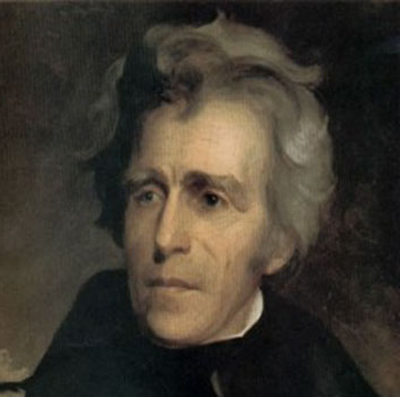
Andrew Jackson
http://img4.wikia.nocookie.net/__cb20120817224533/althistory/images/8/8d/Andrew-jackson-1-.jpg


Recently in history class, we have been learning about Andrew Jackson, the 7th president of the United States, and whether or not he should be known as "the people's president,"  which was a nickname given to him by the people of the United States.  The essential question for this unit was "Is Andrew Jackson's long-standing reputation as "the people's president" deserved?  Why?  Why not?" To answer this question, my class divided into groups to study three major events of his presidency: the bank war, indian removal, and the spoils system.  After looking at sources and watching videos about our assigned event, the groups made creative projects, which demonstrated the success/ failure of the event.  My group wrote and performed a skit on the bank war, and watched the presentations from the other groups.  By learning about each event through the presentations, we were able to determine that Andrew Jackson tried his best to be "the people's president," but sometimes didn't live up to his expectations.

This is the script for the skit my group presented in class about Andrew Jackson and the Bank War.

The bank war, the spoils system, and indian removal prove that Andrew Jackson tried, but sometimes failed, to be "the people's president."  During the bank war, Andrew Jackson wrote a bank veto message to congress, which stated that he didn't approve of the high amount of rich stockholders in the bank.  Jackson didn't support the high amount of power the banks, especially the Second Bank of America, had, and thought that the banks were not beneficial to the poorer classes.  20 out of 25 of the bank directors at this time were chosen by the rich bank stockholders, and only 5 were chosen by the government.  The bank did not follow the system of checks and balances, and Jackson strongly believed that the middle and lower classes should have more power over the bank.  Andrew Jackson was definitely "the people's president" during the bank war, and he was determined to change the banks.  When Daniel Webster replied to his bank veto message, Webster said that the veto was close to absolute monarchy, and that Jackson was extending his grasp over every branch of government and setting the poor classes over the rich ones.  Despite this, Jackson succeeded and helped the majority of Americans by improving the bank system.

I watched presentations on the other two big events of Andrew Jackson's presidency, and used these presentations, as well as my own, to predict whether or not Jackson was "the people's president."  During the indian removal, Jackson tried to persuade the Indians living in areas such as Florida and Georgia to move out west.  He told the Indians to either move out west, or stay and obey American laws, and Congress declared his Indian Removal Act unconstitutional.  Around 100,000 Indians had to move, and many died on the Trail of Tears.  Jackson did not care for the Native Americans, because he let so many die, but was still "the people's president" because His intention when he made the Indians leave was to make everyone else happier.  In the spoils system, Andrew Jackson promised people good jobs if they voted for him as president.  "Spoiling" his followers was intended to keep himself in office as long as possible, which is a highly selfish act.  By initiating the spoils system, Andrew Jackson was trying to be "the people's president," but failed.  In all three events, Andrew Jackson was trying to live up to his expectations as "the people's president," and he succeeded during the bank war, but failed during the spoils system and indian removal.

Wednesday, December 3, 2014

The Early Failures of Democracy in the United States

This is my group's Glogster on Democracy in the United States.
This week in my honors history class, we have been studying the rise of democracy in the United States in the early 1800s.  In groups of five or six, we read documents and analyzed primary sources in order to answer the essential questions. My group answered the questions How should we define democracy? and How democratic was the United States in the early 1800s? by creating a Glogster, a type of digital poster.  We discovered that democracy is a type of government in which the entire population participates, and that the United States was not very democratic in the early 1800s and was struggling to run its states through a democratic government.  Our Glogster (link below) presents information on the rise of democracy well, and describes each document and event from this time period with images.

Link to my Glogster:  http://grouplmnop.edu.glogster.com/rise-of-democracy/

Tuesday, November 25, 2014

All Human Beings Deserve Respect - Latin America Revolutions

The social classes in 1800s Latin America were not equal, with the highest social class making up 1% of the total population.
I made this pie chart with my class in my Evernote account.


It is commonly known that every human should be treated with dignity, regardless of their race, but in the early 1800s, every race was treated differently.  It is important to think about the questions,  Why is it essential to acknowledge human value regardless of race? and, How are the events in the Latin American Revolutions evidence of this social imperative? because they can help anyone appreciate people for being of a different race than themselves.  If everyone knew and understood this information, then groups wouldn't have to revolt for their independence, like the people in Latin America did.  My history class found the answers to these questions by dividing into three groups, one for each of the revolutions of Gran Columbia, Mexico, and Brazil, and analyzing our group's revolution by creating a timeline of events.  Afterwards, we broke apart and shared our revolution timelines with the other groups.  Our exploration of the Revolutions of Gran Columbia, Mexico, and Brazil prove that all human beings deserve dignity and respect, regardless of their race.

This is the timeline of events for the Revolution of Gran Columbia, made by a group in my history class.

The timeline of the Revolution of Gran Columbia (above) shows how the independence of the Republic of Columbia from Spain provided freedom for its people, and shows that people of different races were able to be freed in Latin American countries.  The Revolutions of Mexico, Gran Columbia, and Brazil have commonalities and differences.  All of the revolutions were seeking independence from a mother country, and their mother countries were getting in the way of their independence.  Also, each of the revolutions were successful.  However, they all took place in different parts of Latin America, and involved different rulers fighting for independence.  Simon Bolivar was the leader from Gran Columbia, while Pedro was the Brazilian leader, and Miguel Hidalgo and Iturbide were the leaders of the Mexican Revolution.  even though independence was achieved in all three revolutions, race influenced the decisions in each of them.  In Brazil, Pedro surrounded himself with Portuguese born ministers because other elites weren't allowed to be part of the government.  During the Gran Columbian Revolution, Bolivar's way of thinking was different from other peoples' because was Venezuelan and came from a family of aristocrats, but was raise by slaves.  In Mexico, under the rule of Iturbide, Mexicans of mixed or pure Indian blood would less rights than the Spaniards or Portuguese.  Even after independence had been achieved in Latin America racial rights were still an issue, and sometimes remain an issue today.

Not as many racial problems exist today as they did in the 1800s, but sometimes people still aren't treated equally because of their race.  It isn't fair that some people are not treated kindly by their government and peers, and sometimes crimes are committed between people of different races.  Occasionally, the government will treat an African American person worse than they treat a caucasian, and this can be fixed.  This problem is still an issue, and everyone should consider the issue of race in their lives.   No one should pay attention to the color of the sin of their peers, because it might affect their opinion on that person.  Being treated in  bad way isn't fun for anyone, so everyone should try to stop racial injustice.  This issue has existed for hundreds of years, like during the Latin American Revolutions, and it is time to bring it to a stop.

Monday, November 10, 2014

The Revolutions of 1830 and 1848: Complete Failures or Not?

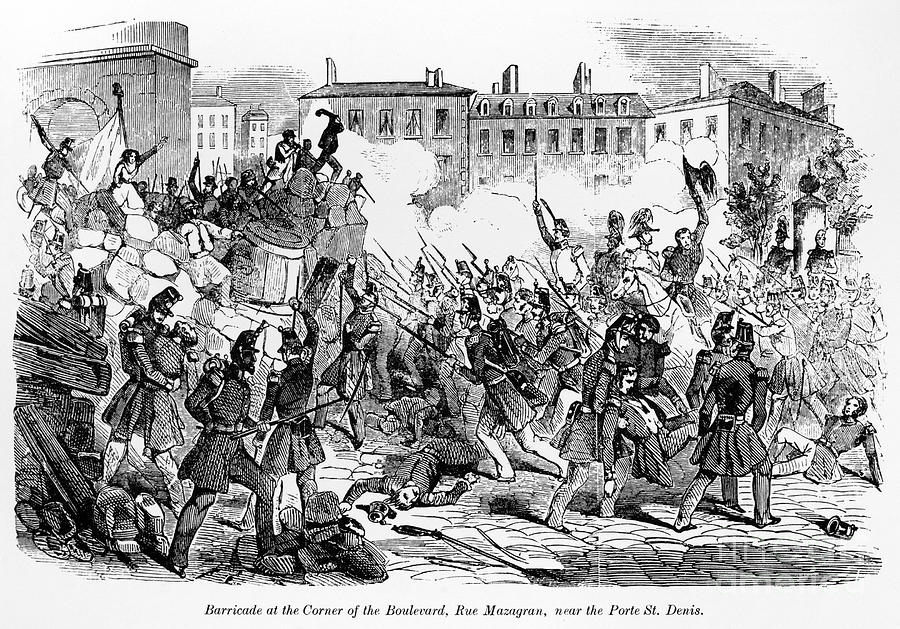
This image shows the barricade the French citizens made during the French Revolution of 1848.
http://images.fineartamerica.com/images-medium-large/2-france-revolution-1848-granger.jpg

Link to our Survey Monkey on the French Revolution of 1848: https://www.surveymonkey.com/s/MJMFW6J

Were the revolutions of 1830 and 1848 really failures as many historians have concluded?  To answer this question, my history class split into five groups, and each group analyzed a revolution from that time period.  Next, each group made a survey monkey for their revolution.  A survey monkey is a type of survey you create on an electronic device, which can be taken by anyone else.  After reading documents on the revolutions, we took the surveys.  Finally we ranked each revolution on how good or bad it was.  My classmates learned from my group's Survey Monkey well because most oft the answers were correct, as shown in the images below.  Historians have concluded that these revolutions were all complete failures, but most of them weren't.  I think that the historians were partially wrong, because the revolts were partially successful, and many people that started them got some of the rights they were asking for.

80% of my classmates identified the main idea in our first primary source, after reading  an article on the revolution.


My group studied and created a survey monkey on the French Revolution of 1848.  During this revolution, lower and middle class liberals revolted against the french government because they wanted political, economic, and social reforms.  In the first part of the revolution, February Days, King Louis Philippe created more jobs for the poor, but during the second part, June Days, the upper and middle classes took control and got rid of the working class's jobs.  Louis Philippe gave up his throne and the French people voted for a president.  A primary source written by Victor Hugo, author of Les Miserables, describes the barricades made by the french people to defend themselves from the government.  It says, "You saw there, in chaos full of despair, rafters from roofs, patches from garrets with their wall paper, window sashes with all their glass planted in the rubbish, ..." The end results were mixed:  the number of citizens that could vote increased from 200,000 to 9 million, but new president Louis Napoleon declared himself emperor and became too controlling.  Although the economy grew during Louis Napoleon's reign and the number of voters increased, France was still under a monarchy.  Another primary source, written by the National Assembly of France, says that the people of France wanted to become united and not have to live under a monarchy any more: "Citizens: royalty, under whatever form, is abolished; no more legitimism, no more Bonapartism, no regency."  This goal happened because Louis Napoleon became emperor.  The French revolution of 1848 was not a failure as historians have said, because the results were fairly neutral.  


About 70% of my class answered that the middle class liberals wanted moderate political reforms during the French Revolution of 1848.

The revolutions of 1830 and 1848 were the Decembrist Revolt, the French Revolution of 1830, the French Revolution of 1848, the Frankfurt Assembly, and the Hungarian Revolution of 1848, and only the first one was a complete failure.  The Decembrist Revolt was a failure because  the peasants of Russia wanted more rights and a new constitution, but didn't receive either of them.  Besides this, all the other revolutions were classified as neutral/failure, neutral, or neutral/success.  For example, during the Frankfurt Assembly, workers wanted national unity for Germany and liberal reforms, and the results were not a complete failure.  The citizens kept trying to get the reforms, and almost succeed, but the king turned them down in the end because he was a conservative.  Also, in the Hungarian Revolution of 1848, Hungarian nationalists wanted an independent government, the end of serfdom, and a constitution to protect basic rights.  The government agreed to these changes because they were overwhelmed, but they eventually returned to the way they were before.  Although the revolutions of 1830 and 1848 weren't really successes, the revolters received some of their rights.  Historians who believe that the revolutions of 1830 and 1848 are total failures are wrong because the revolutions inspired future revolutionists to change the previous revolt techniques, which helped the future revolutions succeeded.  


Primary Source Citations:

1848: Hugo's Description of the Barricade Excerpt from Les Miserables, Victor Hugo 1862
https://www.mtholyoke.edu/courses/rschwart/hist255/la/1848barricade.html

Documents of the Revolution of 1848 in France J. H. Robinson, ed., Readings in European History (Boston: Ginn, 1906), 2: 559-562 Hanover Historical Texts Project


Monday, October 27, 2014

Impacts of the Congress of Vienna

This is an image of Prince Metternich, representative of Austria during the Congress of Vienna.
http://www.desmondseward.com/wordpress/wp-content/uploads/2012/05/metternich1.jpg


When we studied the Congress of Vienna in history recently, the essential question was "What should people in power do when their power is threatened?"  The Congress of Vienna in 1813 was the chaotic event in which the leaders of Austria, Prussia, France, Britain, and Russia tried to find a way to recover and reconstruct European countries that had been destroyed during Napoleon's reign.  To discover the answer to the essential question, we divided into groups, and tried to predict the leaders' decisions.  The leader of the Congress of Vienna was Prince Klemens von Metternich from Austria,  was viewed as a selfish and vain person, and was certainly not the ideal person to decide the fate of Europe.  After predicting Metternich's decisions, we found out the real results of the Congress of Vienna, and discovered why the leaders of Europe initiated certain concepts after their power had been threatened by Napoleon.

The concepts created by the leaders of Austria, Prussia, France, Britain, and Russia were Balance of Power, Principle of Legitimacy, Holy Alliance, and Principle of Intervention.  Holy Alliance, initiated by Czar Alexander of Russia, stated that monarchs had the divine right to rule, and that any revolution was treason against God.  Of the five countries represented at the Congress of Vienna, only England did not take part in this concept because it was Anglican, not Catholic.  Holy Alliance was used by European countries after Napoleon's reign because they thought it would help eliminate threats to their country's power and would prevent revolutions from taking place.  This concept worked for a while after the Congress of Vienna, like when the Austrians crushed an Italian uprising during the 1820s.  Holy Alliance, along with the other major concepts, prevented wars between the five powers of Europe until 1853.  In addition to preventing war, the congress also viewed Napoleon as the enemy, not France.  France had to make some reparations to the other allies, and then had to follow the laws initiated during the Congress of Vienna.

The representatives from the Congress of Vienna may not have been the ideal people to make historic decisions, but the ones they make were effective enough to protect their power and prevent wars.  I think that some decisions made during the congress were good, while others weren't as acceptable.  Holy Alliance definitely prevented wars, and was effective through most of Europe.  Also, Balance of Power restored balance between the five major european countries, and Principle of Intervention, which stated that countries could intervene if another country was causing chaos, was a great way to stop uprisings.  On the other hand, Principle of Legitimacy stated that lawful monarchs should be restored.  It would have be more useful to give the people some power, but Metternich was a conservative, and didn't believe in changing around the laws too much.  Although he didn't want to change Europe entirely because of his beliefs, and because he wanted to keep his power, he didn't help the circumstances in other countries.  The situation of Europe was in so much peril that powerful countries could have offered to give away some power, but the leaders at the Congress of Vienna wanted to keep theirs.  Powerful countries should be willing to give away power when needed to help the situations of others, even if their power is threatened.

Tuesday, October 21, 2014

Ideologies - Liberalism, Conservatism, and Nationalism


Recently in history class, we completed a project in order to help us learn about 19th century ideologies and answer the current essential question.  To answer the question "What were the major political ideologies of the 19th century and how did they influence social and political action?" we first had to figure out what an ideology is.  An ideology is a system of ideas that form the basis of economic and political theory and policy, or in other words, a group of ideas that shape a society. The three most important ideologies of the 19th century were liberalism, conservatism, and nationalism.  My class learned more about each of the ideologies by splitting into six groups, two for each ideology, and reading about the ideology our group was assigned.  Then, we created an imaginative presentation of our ideology and went head to head with the other group of the same ideology.  The class voted on which presentation was both creative and demonstrated our knowledge of the ideology.  I learned about all of the ideologies, including conservatism, for which my group made an educations video.

Link to my group's presentation:
https://www.educreations.com/lesson/view/conservatism-project/25421356/?ref=link&s=gX4L2P

Conservatism is a traditional ideology that argued that time-tested traditions were the only solutions to social and political problems.  Conservatives believed that monarchy and church power were the best forms of government because they had worked for generations without fail.  Reforms and constitutionalism resulted in violence multiple times in history, like during the French Revolution,  so conservatives used this as proof that these systems did not work.  They only believed in using old, stable systems of government, and never tried new ones.  British writer and statesman Edmund Burke and French writer Joseph de Maistre were conservatives, and predicted the chaos that resulted from the resolutions in the 19th century.  In the 1800s, conservatives avoided having revolutions, and tried to maintain monarchies.  

After watching the other groups' presentations, I was able to decide how the other ideologies worked. Liberalism is the opposite of conservatism, and is based off of freedom and rights.  All middle/upper class men were allowed to contribute to government, and although they weren't given complete freedom, they had more freedom than people from other ideologies had.  Liberalists liked creating new laws and new ways to live their lives, and were in favor of meritocracy.  British philosophers John Locke and Adam Smith argued for individual liberty, and were considered the forefathers of liberalism.  Nationalism is the result of the process when people with similar cultural practices, languages, beliefs, or traditions unite as a whole.  These people then work together to take down a common enemy, and come together as a country.  Germany and Italy used nationalism in the 19th century to become whole countries.  German writers Johann Gottlieb Fichte and Georg Wilhelm Friedrich Hegel helped their country become a whole, after it had been separated during Napoleon's rule.  Conservatism, liberalism, and nationalism were all ideologies, created by philosophers and writers, that helped shape life in 19th century Europe.

Wednesday, October 15, 2014

Did Napoleon Benefit or Harm the World During his Reign?

This portrait of Napoleon Bonaparte shows how he was the most powerful ruler in all of Europe.
http://psi.historicusinc.com/media/export/im_12281_screen.jpg


Napoleon Bonaparte was an influential military leader from France who conquered almost all of Europe during his lifetime.  Between the time of his death and now, Napoleon has developed several reputations from various countries.  In class, we explored different primary and secondary sources to discover whether or not his reputation should be good or bad.  From this activity, I learned that he actually helped France a lot during his reign, and although he took unfair control of most of Europe, the countries mostly benefitted from his rule over them.  Although all the countries he conquered despised Napoleon for ruling them for so forcefully, his impact on the social, political, and economical systems in Europe was mostly positive.

The first primary source we looked at in class was from Madame de Stael, a member of the king's court, whose power was wrecked when Napoleon became emperor.  Madame de Stael thought of Napoleon as a powerful ruler who intruded on the independence of France and Europe, and who persuaded countries with force and cunning.  She thought that Napoleon was ruining people's lives everywhere by controlling their countries in a forceful way.  Next, we looked at a source from Marshal Michel Ney,  one of Napoleon's soldiers, who thought highly of his commander.  He believed that Napoleon had the right to rule over France, and that he would help France's government move forward.  He thought Napoleon was the best person to rule Europe and that he was a wonderful leader.  Madame de Stael and Marshal Michel Ney had contrasting views of Napoleon that were influenced by their relation to him, and show how varied Napoleon's impact was between different people.  Looking at a secondary source is a better representation of his impact because the authors didn't personally know Napoleon.

The article The Lost Voices of Napoleonic Historians (link below) is a collection of views on Napoleon written by various historians.  Most of these historians have a positive view of Napolean, and believe that he primarily helped France and Europe.  These people say that Napoleon was a military genius and a skilled leader, who was given the opportunity to display his skills when he became ruler of France. These historians believe that Napoleon had enlightening views of government that he shared with the countries under his reign, and was definitely devoted to his rule, but as smart as he was, he eventually became too dominant and his power began to exhaust.  Although he was defeated after many years, Napoleon was a genius who was able to manage almost all the countries in Europe under one empire and improve their social, political, and economical systems.

After looking at these sources, I came to the conclusion that Napoleon's impact was mostly positive.  He balanced France's budget, established the bank of France, abolished serfdom, nobility, and people's titles, allowed freedom of religion, gave more citizens access to education, and gave people property rights.  During  his rule, he accomplished a lot and solved many problems in the political, social, and economical systems in every country he touched.  Except when his power became exhausted towards the end of his life, Napoleon made a great impact on the world and should have a better reputation than he currently does.  Napoleon Bonaparte improved the social, political, and economical systems in Europe, and made a good impact during his reign.

Link to The Lost Voices of Napoleonic Historians:
http://www.napoleon-series.org/research/biographies/c_historians.html